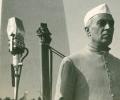
On Jawaharlal Nehru's 61st death anniversary, Utkarsh Mishra recalls how India's first prime minister cultivated a unique role for the newly independent country on the world stage.

National Security Advisor Ajit Doval on Wednesday said that the Shanghai Cooperation Organisation members should respect the sovereignty and territorial integrity and seek no unilateral military superiority in adjacent areas.

Singh emphasised that the Indo-Pacific is no more a maritime construct, but a full-fledged geo-strategic issue, and that the region is facing "a complex web" of security challenges, including boundary disputes and piracy.
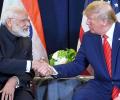
It would be the prime minister's first bilateral visit to the US after Trump became president for a second term.
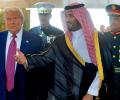
Acutely conscious that he's left with less than four years to create his legacy, Trump is undoubtedly a man in a hurry, observes Ambassador M K Bhadrakumar.
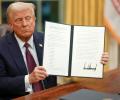
During his inauguration on Monday, President Trump declared a national emergency at the US southern border.
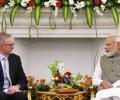
The matter came up for discussion during their wide-ranging dialogue that was aimed at expanding overall ties.
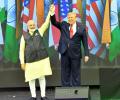
President Trump made these remarks on Monday while talking to reporters aboard Air Force One on his way back to Joint Base Andrews from Florida.
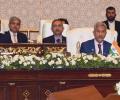
Delivering a thinly veiled message to Pakistan from its soil, External Affairs Minister S Jaishankar on Wednesday said activities across borders characterised by the 'three evils' of terrorism, extremism and separatism are unlikely to encourage trade, energy flows and connectivity.
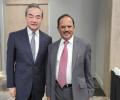
Doval is in Beijing for the 23rd round of the Special Representatives' talks being held after a gap of five years.

'The future of BRICS is under stress as Chinese attempts to expand the platform are being resisted by India and Brazil.' 'Beijing is focused on a quick expansion with the aim of giving the platform a distinctly anti-Western orientation, which New Delhi and Brasilia seem to have no interest in,' notes Harsh V Pant.
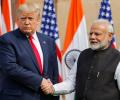
The China threat continues to resonate in the strategic partnership between India and the USA, points out Rup Narayan Das.

Prime Minister Narendra Modi has said that the Quad is not against anyone, but for a rules-based international order and respect for sovereignty, in a veiled reference to China.
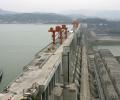
China has approved the construction of the world's largest dam on the Brahmaputra River in Tibet, close to the Indian border. The USD 137 billion project, which is expected to dwarf even China's own Three Gorges Dam, has raised concerns in India and Bangladesh, the downstream riparian states. Concerns in India are centered around China's potential to control water flow, potentially enabling the release of large amounts of water to flood border areas in times of hostilities. The dam is part of China's 14th Five-Year Plan, and the Chinese government claims that the project is safe and prioritizes ecological protection.

It's time India re-visited its Western alliances for the attitude and approach that the West reserves for the nation when it comes to security cooperation of the kind that they might not have visualised outside of China, India's bug-bear, asserts N Sathiya Moorthy.

PM Modi went to New York this time not to engage in polemics, but to find solutions to global problems. He made some progress on several matters, even on reform of the UN Security Council, when the US made a major concession for the first time that six permanent members without veto, including India, could be considered
'What I will say is on the US and India relationship, we believe that it stands on an extremely strong foundation anchored in ties between our people and cooperation across a full range of global issues.'
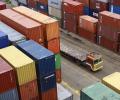
The US Trade Representative noted that India's average applied tariff rate stood at 17% per cent, the highest of any major world economy.

Swedish Prime Minister Lofven lauded India as 'global power' and said the two countries are a 'perfect match'.

Leading oil companies dedicated the second day of India Energy Week (IEW) 2025 to announcing strategic deals and business agreements across the supply chain - from sourcing more crude oil supply to deploying more domestic ships and building gas distribution capacity.
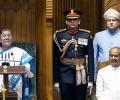
President Droupadi Murmu addressed both Houses of Parliament, highlighting the government's achievements in various sectors, including economic growth, social welfare, and infrastructure development. She emphasized the government's efforts to lift the economy out of "policy paralysis" and create a more inclusive society. Murmu also acknowledged the challenges posed by digital fraud and cybercrime and stressed the need for a social infrastructure revolution. The President's speech is considered a policy statement, outlining the government's vision and roadmap for the future.

President Donald Trump is expected to sign a series of executive orders fulfilling campaign promises, including declaring an emergency at the southern border, addressing a national energy crisis, and defining sex-related policies. The orders aim to address immigration, national security, and energy independence, with a focus on reversing policies implemented by the previous administration.
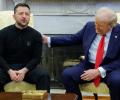
"... It's time to stop this madness. It's time to halt the killing. It's time to end the senseless war. If you want to end wars, you have to talk to both sides," Trump said.

The India-US strategic partnership is characterised by mutual trust and both sides are increasingly in agreement on key issues, such as countering China's aggression, promoting a free and open Indo-Pacific and addressing regional security challenges, Defence Minister Rajnath Singh said on Friday.

'The two sides agree to continue firmly supporting each other in safeguarding their respective core interests,' a joint statement issued at the end of Muizzu's talks with Chinese leaders said.

Indian and Russian officials have discussed Indian-Russian cargo transit along the Northern Sea route, joint projects in Arctic shipbuilding and possible training of Indian sailors for polar navigation.

Prime Minister Narendra Modi on Monday briefed US President Joe Biden in a phone conversation on his visit to Ukraine and conveyed India's full support for the early return of peace to the region through dialogue and diplomacy.

The war and Modi's recent visit to Ukraine is expected to figure prominently in the bilateral meeting, according to US National Security Adviser Jake Sullivan.

United States Secretary of State Antony Blinken will travel to India next week to attend the meeting of G20 foreign ministers and meet senior Indian officials to reaffirm America's strong partnership with the country.

Ahead of his much-anticipated visit to conflict-torn Ukraine, Prime Minister Narendra Modi on Thursday said India firmly believes that no problem can be solved on the battlefield and it is ready to extend all possible cooperation for the restoration of peace and stability in the region.

Although India-US relations have strengthened significantly in recent years, partly because of the security situation in the region, the Indian policy establishment would have to be prepared to protect India's interests in a world that could get more unpredictable.
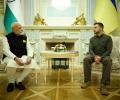
Ukraine and Russia need to engage with each other to find a solution to the ongoing conflict between them, India said on Friday after Prime Minister Narendra Modi held wide-ranging talks with President Volodymyr Zelenskyy in Kyiv under the shadow of the raging war.

In a joint declaration issued after the 16th BRICS Summit in the Russian city of Kazan attended by Prime Minister Narendra Modi and Chinese President Xi Jinping, among others, the leaders reiterated unequivocal condemnation of terrorism in all its forms and manifestations while reaffirming that it should not be associated with any religion, nationality, civilisation or ethnic group.
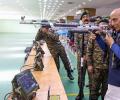
India has declared 2025 as the year of defence reforms, aiming to establish integrated theatre commands to enhance synergy among the three armed forces and transform the military into a technologically-advanced combat-ready force. The reforms will also focus on streamlining acquisition procedures, promoting collaboration, and leveraging emerging technologies like artificial intelligence and robotics.

India and China have agreed to work towards a "roadmap" for rebuilding mutual trust following the border standoff in eastern Ladakh, according to a statement from the Indian Defence Ministry. Defence Minister Rajnath Singh met with his Chinese counterpart Dong Jun in Vientiane, Laos, on the sidelines of a regional security conclave. Singh called for drawing lessons from the "unfortunate border clashes" of 2020 and emphasized the need for cooperation rather than conflict. Both sides agreed to work towards a roadmap for rebuilding mutual trust and understanding, and a meeting of the Special Representatives and Secretary-Vice Minister mechanism will also take place soon.
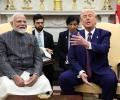
US President Donald Trump and Indian Prime Minister Narendra Modi met in Washington D.C. to discuss a range of issues including trade, defense, and energy. The two leaders announced plans to finalize "wonderful trade deals" for both countries, and Trump emphasized the need for India to purchase US oil and gas. Modi congratulated Trump on his second term and highlighted the importance of working together to further strengthen the India-US relationship. The meeting also addressed the ongoing conflict in Ukraine, with Modi reiterating India's commitment to peace.
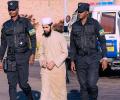
The Central Bureau of Investigation (CBI) has brought back Salman Rehman Khan, an alleged member of the Lashkar-e-Taiba, from Rwanda. Khan was wanted by the NIA for terror-related offences in Bengaluru. He was traced to Rwanda and returned to India on November 28, 2024. The return of Khan comes after similar operations in coordination with Interpol, where two other accused were brought back from Saudi Arabia.

The PM said, 'Regrettably, one of the countries of its origin and spread is in India's neighbourhood.'
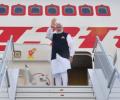
New initiatives to boost cooperation to ensure stability in the Indo-Pacific, ways to find peaceful solutions to the conflicts in Ukraine and Gaza and addressing concerns of the global South will be the focus of Prime Minister Narendra Modi's three-day visit to the US beginning Saturday.
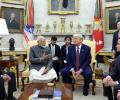
'By his words, actions, and body language during their joint press appearance wanted to convey his personal respect and, more broadly, his desire to work closely with India.'
